
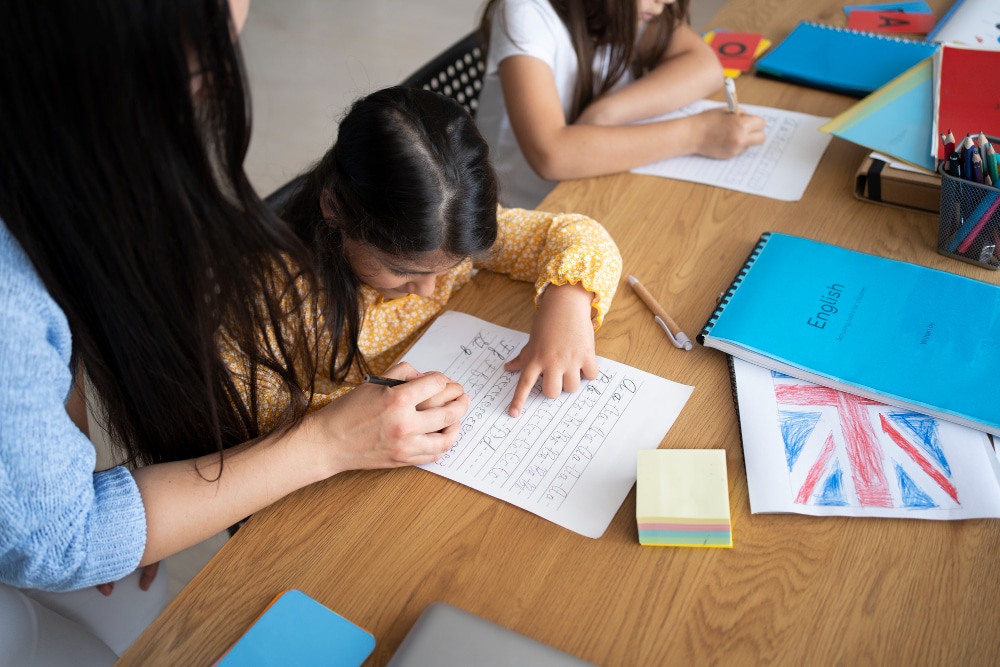

You’ve probably said it out loud or at least thought it: My child just doesn’t like to write. Maybe it comes with a side of guilt, a little self-doubt, or the creeping fear that you’re somehow failing them as their parent. At Essentials in Writing, we hear this from homeschool parents constantly. The first thing we want you to know is this: you are not alone and you are not failing.
Writing resistance is one of the most common frustrations in home education. It shows up in the form of slammed pencils, blank pages, dramatic sighs, and the classic “I don’t know what to write!”
Here’s a reframe worth holding onto: A child who resists writing is not a child who can’t write. Reluctance and inability are two very different things. What looks like stubbornness or laziness is often just the display of something much deeper beneath the surface.
It may be overwhelm, under-preparation, or simply never having been shown how. Knowing how to help a child struggling with writing starts with changing how you see the situation.
Why So Many Children Struggle with Writing
Writing is genuinely one of the most cognitively demanding tasks we ask children to do. Stop and think about what’s actually happening when a child sits down to write. They have to generate ideas from thin air, organize those ideas into something logical, translate thoughts into sentences, apply grammar rules, spell correctly – and they have to do all of this at the same time.
Many of these steps are automatic for adults, but for kids? It’s like asking someone to juggle while riding a bike before they’ve learned to do either separately. No wonder so many children feel overwhelmed before they’ve written a single word. More often than not, it stems from a brain that hasn’t yet been given the right tools to make writing feel manageable.
Families who invest in a quality K-12 homeschool writing curriculum developed around step-by-step instruction often see a dramatic change in how their child approaches the page. Most kids don’t struggle because they have nothing to say. They struggle because no one has broken the process down into steps small enough to actually follow.
When Writing Resistance Becomes a Daily Battle
Resistance to writing is often accompanied by telltale signs. The child who suddenly “needs water” the moment writing time starts. The one-sentence paragraph produced after 45 minutes of coaxing. The dramatic meltdowns, the “I don’t know what to write!”and the glazed-over stare at a blank page are all indications that you’re dealing with a struggling writer.
Writing resistance tends to show up between ages five to fifteen but it can appear at any age. It doesn’t discriminate by grade level, learning style, or natural ability. Parents, especially homeschooling parents, tend to internalize it as failure. “If my child isn’t writing well, what does that say about me as their teacher?”
Here are a few things to note:
- It says nothing about your worth as a parent or educator.
- Parents shouldn’t be expected to be teachers, even in homeschooling. While there is an element of guidance and facilitation, a proper homeschool writing curriculum relies on qualified educators to provide instruction. This lets parents be parents and teachers do the teaching.
- If your child is struggling with writing, the main thing it indicates is that they probably need a different kind of instruction.
The Hidden Problem: Expecting Independence Too Soon
Here’s something most homeschool writing programs don’t talk about: A huge number of curricula assume children can “just write” once they’ve been given a topic. Here’s an assignment, here’s some lined paper, off you go. The result is predictable: Frustration, avoidance, and a child who becomes increasingly convinced they are “bad at writing.”
Independence without preparation backfires. When children haven’t been shown how to construct a sentence, develop a paragraph, or organize their thoughts, asking them to write independently isn’t an exercise in creativity. It’s an exercise in confusion. Modeling matters enormously but most programs skip it entirely.
This is especially visible during the middle school years when writing demands spike and the gap between what’s expected and what’s been taught becomes impossible to ignore. Parents searching for middle school writing programs often arrive at that point already exhausted, having watched a child disengage for years without understanding why.
Why Changing the Narrative Around a Reluctant Writer Actually Matters
“He’s not a writer.” “She hates writing.” “He’s behind.” When those messages settle in a child’s mind or a parent’s, they start to shape what feels possible. They become self-fulfilling prophecies in the worst of ways. Children grow into the expectations placed before them, and they also narrow themselves to fit the ones that confine them.
Changing the narrative starts with rejecting those labels. It means looking at a child who struggles with writing and noticing potential instead of a problem. It means choosing to guide rather than to police; to build the conditions that lead to success rather than demanding results without support.
What Actually Helps Struggling Writers
Explicit instruction matters enormously. Not “write a paragraph about your weekend” handed over with fingers crossed. Actual deliberate teaching of how sentences are constructed, how ideas connect, and how paragraphs develop from a central point.
Students need to see writing happen before they’re asked to do it themselves. When a skilled teacher models the process out loud, students can hear each decision as it happens. They see how a single sentence develops into a full paragraph. The work feels less intimidating and much more manageable.
Guided practice comes before independent practice. Releasing responsibility too quickly is one of the fastest ways to undo writing progress. Students need repetition, feedback, and the experience of succeeding at smaller tasks before the bigger ones feel possible.
Consistency Builds Confidence
Writing skill does not develop in a single lesson but grows steadily over time. Short, focused practice completed consistently tends to have a greater impact than occasional long writing sessions. When instruction is broken into manageable pieces that build naturally from one concept to the next, students feel less overwhelmed and have an easier time getting into the groove of writing.
That belief shapes our approach at Essentials in Writing, where lessons are intentionally concise and purposeful. Instead of sitting through lengthy lectures, students move forward in focused increments that build momentum more quickly.
Over time, those regular small successes begin to change how a child sees themselves as a writer. As confidence increases, resistance softens, and the entire writing experience becomes far more positive.
From Reluctant to Confident: What Progress in Writing Really Looks Like
While it would be nice for all students to have an instant “Aha!” lightbulb moment, that’s often not the case. Progress comes from practice over time. It’s unrealistic to expect your child to one day suddenly discover a love of writing; instead, this shift tends to be gradual.
Maybe it looks like your child sitting down to write without needing repeated reminders. Perhaps it’s more willingness to remain present for the entire lesson instead of jumping up to get a snack every five minutes. Or maybe it’s writing three sentences when the assignment only asked them to write one.
The goal is not perfection but consistent progress. When small gains are recognized, children stay engaged long enough to experience lasting growth.
Supporting Independence Without Abandonment
Working alongside children in the early stages of writing instruction is smart teaching. Modeling, prompting, and guiding before stepping back gives students the foundation they need to work on their own eventually.
Independence grows out of strong instruction. It is the outcome of thoughtful teaching, not something that replaces it. The aim is to release responsibility gradually as skills take root.
At Essentials in Writing, certified teachers offer direct instruction to students in every lesson. Parents are not asked to become writing experts because the teaching is built into the program. The lessons carry the instructional load while parents guide and monitor progress. Students receive direction, practice, and meaningful growth with a real teacher leading the process.
A Practical Example of Narrative Shift in Action
Our writing curriculum for homeschoolers and charter schools was developed for the reluctant writer, the overwhelmed learner, and the kid who shuts down the moment a blank page appears.
Lessons are teacher-led, modeled, and delivered in short, bite-sized segments. Concepts are introduced clearly, demonstrated by a certified educator, and then practiced in structured steps before students are asked to apply them independently.
Our curriculum is aligned with National Standards, which is something very few homeschool programs can claim. It is designed to support a wide range of learners, including students with dyslexia, ADHD, dysgraphia, and autism. Writing instruction done well should reach every kind of learner, not just those who find it easy from the start.
Writing Success Starts with the Right Story
A child who struggles with writing today is not destined to a lifetime of disliking it. The outcome depends almost entirely on the instruction they receive and the story told about who they are as learners.
Children rise to meet well-placed expectations. When we stop calling them lazy and start recognizing they’re improperly instructed, when we stop expecting independence before readiness and start building toward it, outcomes change.
Ready to see what structured, teacher-led writing instruction actually looks like in action? Explore our writing curriculum at Essentials in Writing and discover why thousands of homeschool families trust us to teach what matters most, one lesson at a time.