
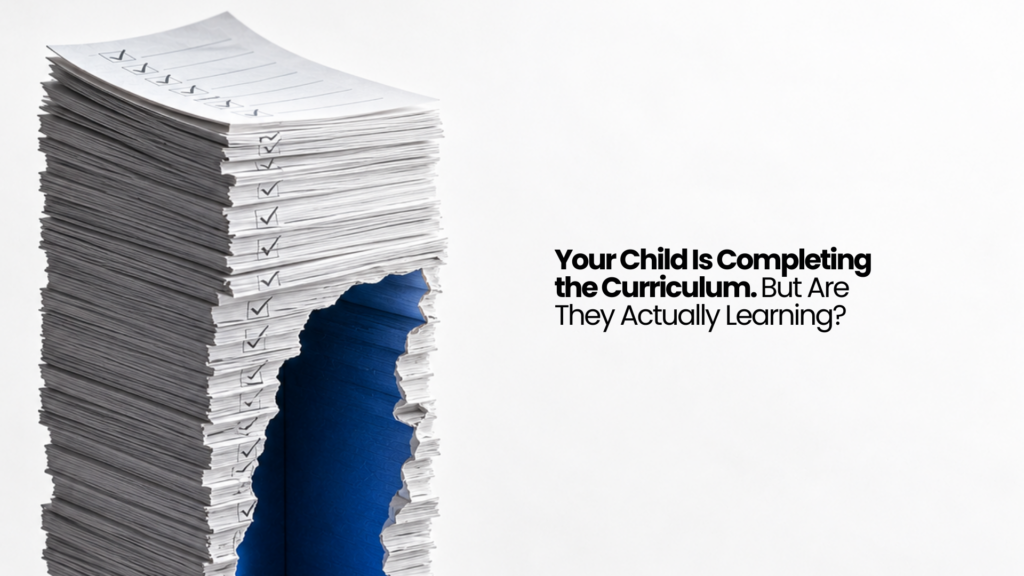

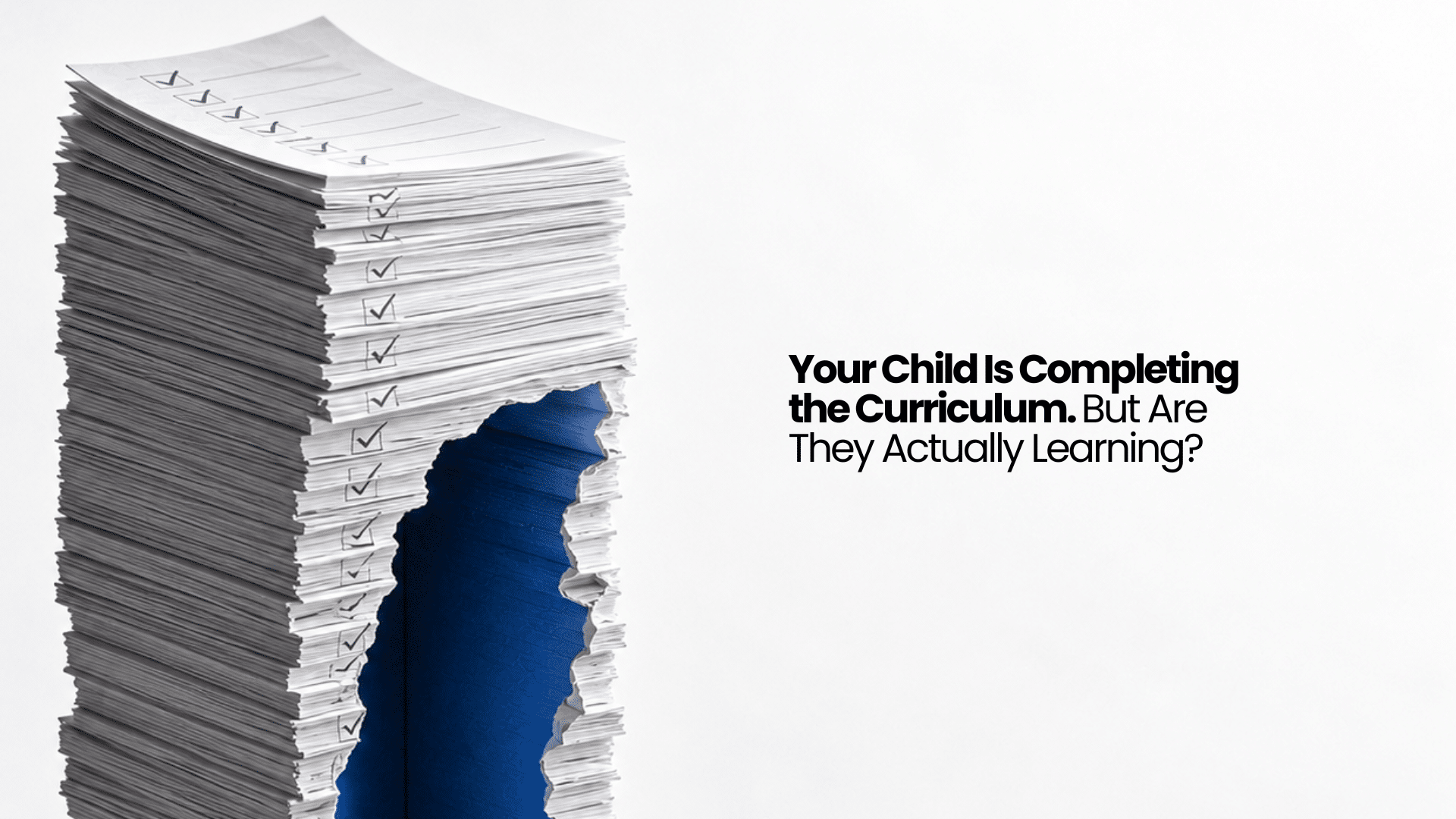
A completed workbook doesn’t necessarily mean your child is learning. Here are five ways to recognize real progress in writing, critical thinking, independent reasoning, and communication.
There’s a certain satisfaction that comes with finishing another week of homeschooling.
The lessons are done. The assignments have been checked. The workbook pages are complete. You look at your schedule and see that you’re right where you should be.
For many homeschool parents, that’s a good feeling. And it should be. Teaching your children takes an enormous amount of time, patience, and commitment.
But there’s a question worth asking, and it’s one that doesn’t always have an easy answer.
Is my child actually learning, or are we simply getting through the curriculum?
It’s an important distinction.
A student can complete an assignment without fully understanding the lesson. They can follow a writing template without knowing how to organize their own thoughts. They can memorize information for a test and struggle to apply it a few weeks later.
None of this necessarily means the curriculum is failing or that your child isn’t making progress. Learning takes time, and some skills require considerable repetition.
But it does mean we need to think carefully about how we measure success.
Finishing the work tells us what a student has completed. Understanding the work tells us what they’ve learned.
And the two aren’t always the same.
Are We Measuring Homeschool Progress the Right Way?
One of the greatest advantages of homeschooling is the opportunity to educate children according to their individual needs.
You can slow down when something isn’t clicking. You can spend more time exploring a subject that interests your child. You can adjust your approach when a particular method isn’t working.
That’s a tremendous advantage.
Yet even with that flexibility, it’s easy to become focused on the schedule.
Are we keeping up?
How many lessons do we have left?
Will we finish everything by the end of the school year?
These are perfectly reasonable concerns. Every parent wants to know their child is progressing academically.
But here’s something to consider.
Imagine two students completing the same writing assignment.
One student writes a five-paragraph essay using a detailed template, sentence starters, and considerable assistance from a parent.
The other writes a shorter essay independently. The writing isn’t perfect, but the student develops an original argument, organizes supporting ideas, and explains the reasoning behind a conclusion.
Both students completed their assignments.
Both may have learned something valuable.
But the second student has demonstrated something particularly important: the ability to apply what they’ve learned without someone else directing every step.
That independence is worth paying attention to.
The purpose of teaching writing isn’t simply to help students produce an acceptable paper. It’s to help them develop the knowledge and confidence to communicate their own ideas.
The same principle applies to nearly every subject.
Five Signs Your Homeschool Child Is Actually Learning
So how do you know whether your child is developing a genuine understanding of what you’re teaching?
There isn’t one perfect measure. Children develop at different rates, and academic progress doesn’t always follow a predictable path.
Still, there are several things parents can look for that tell us much more than a completed worksheet.
1. Your Child Understands WHY, Not Just WHAT
Think about the last time your child completed a writing assignment.
Could they explain why they organized their paragraphs a certain way?
Did they understand why supporting evidence was necessary?
Could they tell you what made one sentence clearer or more effective than another?
Or were they simply following the instructions?
There’s nothing wrong with following instructions. It’s an important part of learning. But eventually, students need to understand the reasoning behind what they’re doing.
For example, knowing that a persuasive essay should contain supporting evidence is useful.
Understanding why evidence makes an argument more convincing is much more valuable.
That understanding allows students to apply the concept when they’re writing about something entirely different.
Something to try at home:
After your child completes an assignment, ask a few questions that begin with “why.”
Why did you choose that example?
Why do you think your argument makes sense?
Why would someone agree or disagree with your conclusion?
You don’t need a perfect answer. You’re listening for evidence that your child understands the choices they’ve made.
At Essentials in Writing, this is a fundamental part of our instructional philosophy.
We believe students need to learn both the HOW and the WHY of writing.
When students understand why something works, they’re better equipped to use that knowledge independently.
2. Your Child Can Use What They’ve Learned in a New Situation
Have you ever noticed that your child can complete an exercise perfectly during a lesson but struggles with the same concept a few days later?
That’s not unusual.
There’s a difference between understanding something while it’s being explained and being able to use it independently.
Educators often refer to this as transfer of learning.
It’s what happens when a student takes knowledge from one situation and successfully applies it somewhere else.
Consider writing.
A student might learn how to construct a persuasive paragraph during a writing lesson.
But can that student use the same skills to explain an opinion about a historical event?
Can they write a letter explaining why something should change in their community?
Can they support a conclusion in a science assignment?
When students begin using skills outside the original lesson, we’re seeing evidence that their learning is becoming more useful and lasting.
Something to try at home:
Give your child a writing prompt they haven’t practiced before.
Don’t provide the same detailed instructions or template they used during the original lesson. Instead, see what they can accomplish with an appropriate level of support.
Pay attention to how they approach the task.
Do they know where to begin?
Can they organize their ideas?
Do they recognize when an explanation needs more detail?
You may discover areas where your child has made considerable progress, along with a few skills that need more attention.
Both are useful things to know.
3. Your Child Is Beginning to Question What They Read and Hear
Children are naturally curious.
Anyone who has spent time with a young child knows how often they ask, “Why?”
But as students get older, we want that curiosity to develop into something more sophisticated.
We want them to question information thoughtfully, examine evidence, and consider whether a conclusion makes sense.
That’s critical thinking.
And it’s becoming increasingly important.
Our children are growing up in a world where information is available almost instantly. They can search for an answer, watch a video, or ask an AI tool to explain practically anything.
Access to information is wonderful.
But access to information doesn’t guarantee understanding.
A student needs to recognize the difference between an opinion and a fact. They need to know that a confident statement isn’t necessarily an accurate one.
They should become comfortable asking questions such as:
- How do we know this is true?
- What evidence supports this claim?
- Is there another reasonable explanation?
- What information might be missing?
- Does the conclusion actually make sense?
These questions are signs of a student who is learning to think rather than simply accept information.
Something to try at home:
Choose a subject your child finds interesting and present two different viewpoints.
Ask them to consider the evidence supporting each position.
Then ask which argument they find more convincing and why.
The goal isn’t to get your child to agree with your opinion. It’s to help them learn how to reach a reasonable conclusion of their own.
This is one reason we place so much importance on writing.
When students must explain and defend their ideas in writing, they have an opportunity to examine the quality of their own reasoning.
4. Your Child Can Express an Original Thought Clearly
One of the things I find most important about writing instruction is that writing gives us a window into how students think.
When children write, they have to take ideas that exist in their minds and organize them so someone else can understand.
That’s not always easy.
A student might have a wonderful idea but struggle to explain it.
Another might be able to write grammatically correct sentences without developing a clear argument.
And another might follow every step of a writing formula but have difficulty writing independently when that formula isn’t available.
These are different challenges, and they require different kinds of support.
Writing templates, graphic organizers, and sentence starters can be helpful teaching tools.
But they should help students develop their own abilities, not become something students depend on indefinitely.
Eventually, we want students to make decisions about their writing for themselves.
What am I trying to say?
What’s the best way to explain it?
What information does my reader need?
Does my argument make sense?
Something to try at home:
Ask your child to write a short response about something they care about.
It might be a favorite book, a historical figure, a community issue, or even a family decision.
When you read their work, don’t focus exclusively on spelling and grammar.
Look at the ideas.
Can you follow what they’re trying to communicate?
Have they explained their reasoning?
Does the writing reflect their own thoughts?
And perhaps most importantly, are they becoming more capable of doing this independently?
At Essentials in Writing, we use explicit instruction, teacher modeling, and scaffolding to help students develop these skills.
We want students to understand the writing process well enough to use it confidently, rather than simply memorize a formula.
5. Your Child Can Recognize Mistakes and Make Improvements
Think about how often we correct our children’s work.
We point out a misspelled word, identify a grammatical error, or explain why a sentence doesn’t make sense.
That’s part of teaching.
But something particularly encouraging happens when students begin recognizing these problems themselves.
They read a paragraph and realize it isn’t clear.
They notice that their argument needs stronger evidence.
They identify a sentence that doesn’t quite express what they intended.
Then they make a change.
That ability to evaluate and improve their own work is an important part of becoming an independent learner.
Researchers often describe this as metacognition, which involves understanding and monitoring our own thinking and learning.
The Education Endowment Foundation has examined research on metacognition and self-regulation, highlighting the benefits of teaching students to plan, monitor, and evaluate their learning.
For homeschool parents, there’s a practical lesson here.
We don’t always need to be the first person to identify what’s wrong with an assignment.
Sometimes, we should give our children an opportunity to discover it themselves.
Something to try at home:
Before correcting a writing assignment, ask your child to read it again.
Then ask:
What do you like most about what you’ve written?
Is there anything you think could be clearer?
Did you explain everything your reader needs to know?
What would you change if you had another opportunity?
You might be surprised by what they notice.
And when a child begins making thoughtful improvements without being told exactly what to change, that’s progress worth celebrating.
Why Writing Tells Us So Much About How a Child Is Learning
Writing is sometimes treated as just another subject on the homeschool schedule.
Math at 9:00. Science at 10:00. Writing after lunch.
But writing is much more than a subject to complete.
It is one of the ways students learn to organize and communicate what they understand.
Think about everything involved in writing a thoughtful paragraph.
A student has to decide what they want to say, determine which information matters, organize their thoughts, and communicate those ideas in a way someone else can follow.
If they’re making an argument, they also need to consider evidence and explain why their conclusion makes sense.
These skills are useful far beyond writing class.
They’re relevant when students explain a scientific concept, evaluate historical events, participate in discussions, or make decisions in everyday life.
The National Council of Teachers of English recognizes the importance of evaluating writing in ways that support learning and account for the context and purpose of the work.
For parents, that means a single grade or completed assignment doesn’t tell the whole story.
It’s often more useful to look at writing samples over time.
Compare something your child wrote at the beginning of the school year with something they’ve written recently.
Are their ideas more organized?
Are their explanations clearer?
Are they supporting their conclusions more effectively?
Do they need less help?
These changes may not always appear in a workbook score, but they can reveal meaningful academic growth.
Every Child Learns Differently. Our Instruction Should Reflect That.
If you’ve homeschooled for any length of time, you already know something that can be easy to overlook in education.
Children don’t all learn the same way.
Some students pick up writing concepts quickly. Others need more time, repetition, and support.
Some children have wonderful imaginations but struggle to organize their thoughts on paper.
Others understand complex subjects but find the physical process of writing difficult.
A reluctant writer may need smaller, manageable assignments to build confidence.
A student with ADHD may benefit from shorter lessons and clearly defined steps.
A student with dysgraphia may need accommodations that allow them to demonstrate their understanding without being limited by handwriting difficulties.
Gifted and twice-exceptional students may need additional intellectual challenges while receiving support in areas where they struggle.
The point is that learning doesn’t look identical for every child.
And it shouldn’t have to.
At Essentials in Writing, we’ve never believed that one size fits all.
Our curriculum was intentionally developed to provide clear, structured instruction while giving parents and educators flexibility to address individual learning needs.
Through video-based lessons, teacher modeling, guided practice, and scaffolding, students are introduced to writing concepts in manageable steps.
Parents can adjust pacing, revisit lessons, and provide additional support where necessary.
The objective isn’t to make every student write the same way.
It’s to help each student become a more capable, confident, and independent writer.
Explore the Essentials in Writing curriculum for grades 1–12.
Are You Helping Your Child Finish, or Helping Them Become Independent?
This is something worth thinking about, particularly when a child is struggling.
As parents, our natural instinct is to help.
We explain the assignment, suggest an opening sentence, reorganize a paragraph, or point out what needs to be corrected.
Sometimes that’s exactly what our children need.
But over time, the amount and type of assistance should change as students become more capable.
Here’s a simple way to think about the difference.
| When the focus is completion | When the focus is learning |
| Following a writing template | Understanding how to organize ideas |
| Repeating information | Explaining ideas in their own words |
| Correcting errors when prompted | Recognizing and correcting errors independently |
| Including evidence because it’s required | Understanding why evidence supports an argument |
| Finishing with extensive assistance | Completing work with increasing independence |
| Receiving a grade | Understanding feedback and using it to improve |
None of the activities in the first column are necessarily bad.
In fact, many are important parts of learning.
The question is whether students are gradually moving toward the abilities in the second column.
That’s where meaningful progress becomes easier to recognize.
A Simple 15-Minute Exercise to Check Your Child’s Progress
You don’t need to administer a formal test every time you want to understand how your child is progressing.
Sometimes, a short writing exercise can tell you quite a bit.
Try this once a month.
First, choose a question your child hasn’t practiced before.
For example:
“Should students have more freedom to choose what they study? Explain why or why not.”
Choose something appropriate for your child’s age and writing ability.
Next, give them about seven minutes to respond.
Younger students may write only a few sentences. Older students may be able to develop a paragraph or short essay.
Provide accommodations where needed, but try not to supply the ideas or structure.
Then, spend a few minutes discussing their response.
Ask why they chose their position.
Ask what evidence supports their opinion.
Ask whether someone might reasonably disagree.
Finally, ask what they would improve.
Save the assignment.
A month later, repeat the exercise with a different but comparable question.
Over time, compare the responses.
Look for clearer explanations, stronger organization, better reasoning, and increasing independence.
This isn’t a standardized test, and it shouldn’t replace other appropriate assessments.
It’s simply one way to observe how your child’s thinking and communication are developing.
What Should You Look for in a Homeschool Writing Curriculum?
If you’re evaluating a homeschool writing curriculum, it’s worth looking beyond the number of lessons, assignments, or workbook pages.
Those things matter, but they don’t tell you everything about the quality of instruction.
Consider asking:
Does the curriculum explain writing concepts clearly?
Does it teach students why effective writing works?
Are students shown how to develop ideas before being expected to write independently?
Does instruction progress from manageable skills toward more complex writing?
Can parents adjust the pace or provide accommodations when necessary?
Does the curriculum help students become less dependent on templates and step-by-step assistance?
And perhaps most importantly, does it help students develop the ability to communicate their own ideas?
These are the questions that should guide curriculum decisions.
At Essentials in Writing, our approach is built around direct instruction, teacher modeling, structured practice, and progressive skill development.
Our writing curriculum serves grades 1–12, and we offer optional scoring services for levels 6–12 to provide additional feedback on student writing.
Our literature courses for grades 7–12 complement writing instruction by providing opportunities to develop reading comprehension, analysis, and thoughtful responses to literature.
We want students to understand what they’re learning and become increasingly confident applying those skills.
Because our goal isn’t simply to help families finish another school year.
It’s to help students build abilities they can carry with them long after the school year is over.
Frequently Asked Questions About Homeschool Learning Progress
How do I know if my homeschool child is actually learning?
Look at what your child can explain, demonstrate, and apply independently. Completed assignments are useful, but so are writing samples, discussions, unfamiliar problems, and the ability to use previously learned skills in new situations.
What are signs that a homeschool writing curriculum is working?
Look for clearer organization, stronger reasoning, more effective communication, thoughtful revision, and increasing independence. Compare writing samples over time rather than relying on one assignment or grade.
How can I teach critical thinking in my homeschool?
Encourage your child to ask questions, examine evidence, compare different viewpoints, and explain the reasoning behind their conclusions. Writing assignments that require explanation and persuasion are useful opportunities to practice these skills.
What if my child struggles with independent writing?
Start with clear instruction and manageable assignments. Use modeling and guided practice, then gradually reduce assistance as your child develops confidence. Students who have specific learning challenges may also benefit from accommodations and additional support.
Does completing a homeschool curriculum mean my child is at grade level?
Not necessarily. Curriculum completion indicates that material has been covered, but proficiency depends on what the student understands and can demonstrate. Writing samples, independent work, and appropriate assessments can help parents develop a more complete picture.
The Question Worth Asking at the End of the School Day
At the end of a busy homeschool day, it’s natural to ask whether everything got finished.
Did we complete the lessons?
Did we check the assignments?
Are we still on schedule?
Those questions have their place.
But there’s another question I believe deserves just as much attention.
What can my child understand, explain, or accomplish today that they couldn’t do before?
Maybe they wrote a paragraph without needing as much help.
Maybe they questioned something they read and supported their opinion with evidence.
Maybe they recognized a mistake and corrected it on their own.
Maybe they finally understood a concept that had been difficult for weeks.
Those moments matter.
They may not always be reflected in a grade or a completed workbook, but they tell us something important about the learning taking place.
One day, our children will finish their schooling.
They won’t have a workbook telling them what to do next. They won’t always have a teacher or parent available to explain every step.
They’ll need to evaluate information, solve problems, make decisions, and communicate with other people.
We want them to be prepared for those moments.
That’s why I believe the purpose of education should extend well beyond curriculum completion.
At Essentials in Writing, we want students to become capable writers, thoughtful learners, and confident communicators.
We want them to understand not only how to complete an assignment, but why the skills they’re learning matter.
And we want them to develop the independence to use those skills throughout their lives.
Because the real measure of education isn’t simply what a child has completed. It’s what that child has learned to do.
Your Child Deserves More Than a Completed Workbook
If you’re looking for a homeschool writing curriculum that emphasizes clear instruction, critical thinking, effective communication, and the development of independent writers, we’d love for you to explore Essentials in Writing.
Our curriculum for grades 1–12 teaches students the HOW and the WHY of writing through intentional instruction, teacher modeling, and structured skill development.
Whether your child is a reluctant writer, an advanced learner, or someone who needs a different approach, our goal is to help you provide the instruction and support they need to grow.
Because finishing the curriculum matters. But what your child learns along the way matters so much more.